Your bill, explained
Your SCE bill, explained
Page 1
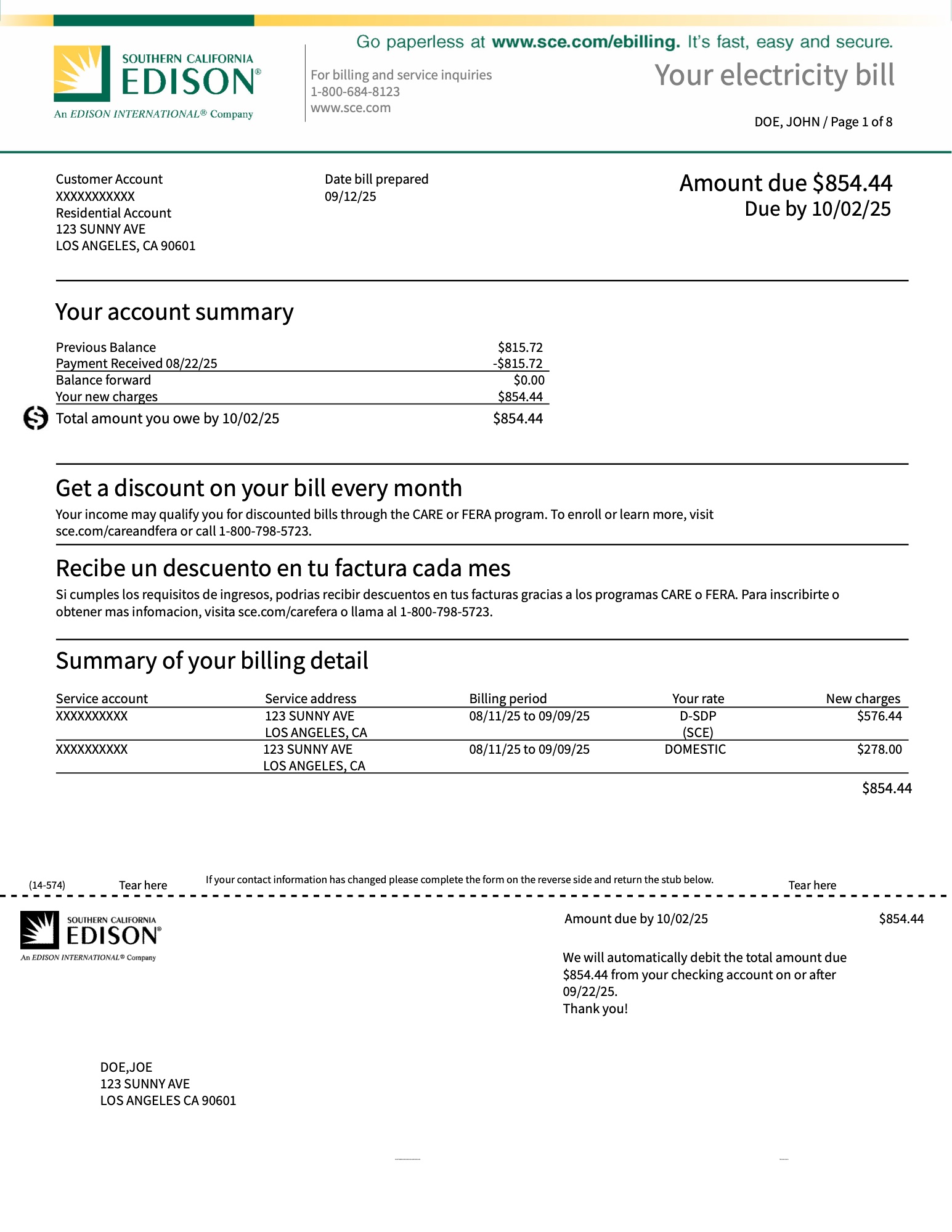
$854.44 for one month
Everything on the bill. SCE bills every month.
Line 1: SCE delivers it
$576.44 to bring power to the house: the wires, programs and taxes. Rate D-SDP.
Line 2: the power itself
$278.00 for the electricity, from Clean Power Alliance. SCE still delivers it and sends one bill.
About 40¢ per kWh, all in
Both lines together, divided by the kWh used. Always add both.
$854.44÷2,144 kWh=39.9¢
Page 4
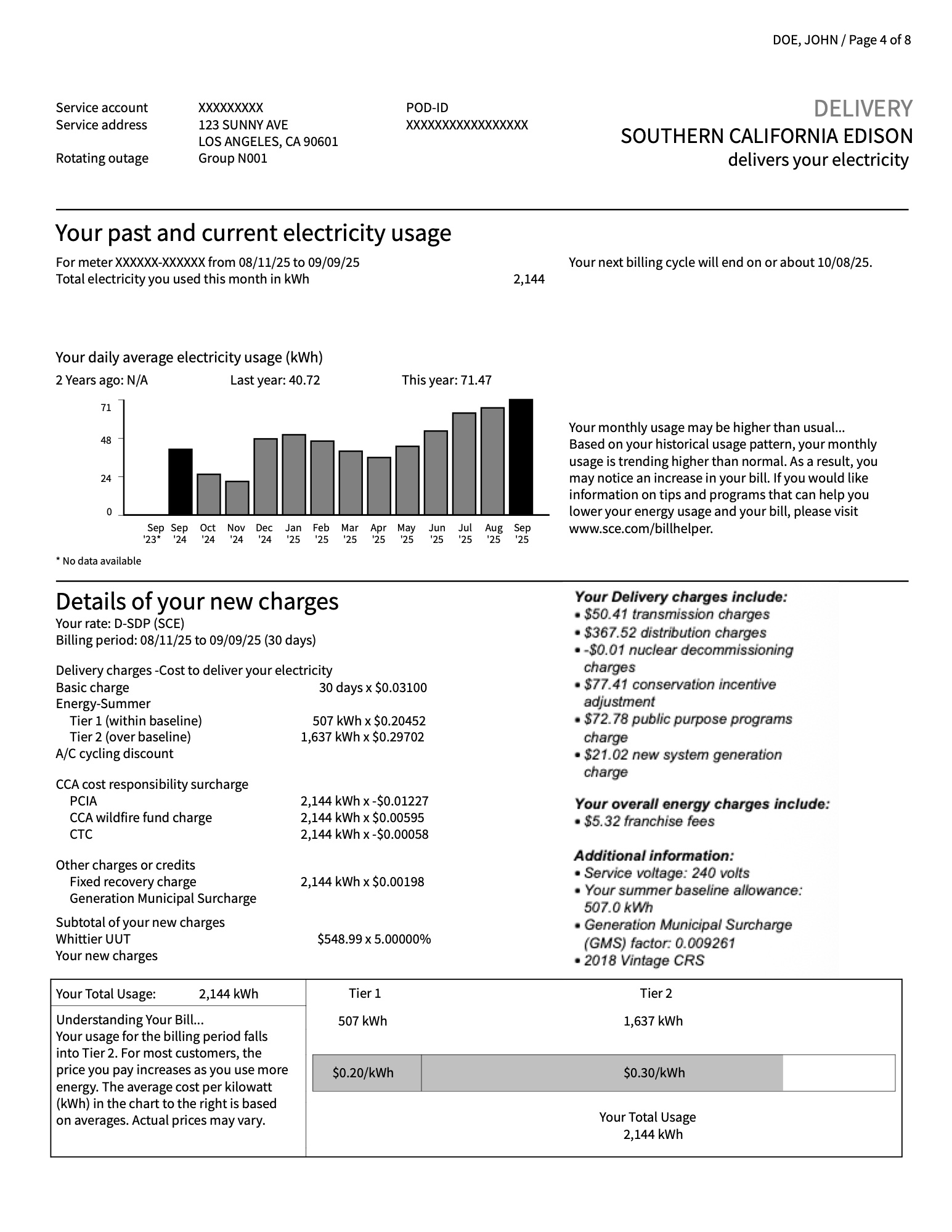
2,144 kWh in 30 days
About 17,000 kWh a year
Each bar is the average kWh per day for one month. Add the last 12 (each bar times its days) and this home uses about 17,000 kWh a year: the number a system is sized to.
≈ 46.5 kWh a day×365=17,000 kWh
D-SDP: tiered, with an A/C credit
Schedule D prices by tier. SDP is the Summer Discount Plan: a credit for letting SCE cycle the A/C on peak days.
PCIA: about −$26.31
Power Charge Indifference Adjustment, 2,144 kWh × −$0.01227. Settles the cost of power SCE bought before this home switched providers. A credit this month.
Wildfire fund: about $12.76
2,144 kWh × $0.00595, paid into California's Wildfire Fund.
CTC: about −$1.24
Competition Transition Charge, 2,144 kWh × −$0.00058: left over from California's 1990s power deregulation.
Fixed recovery: about $4.25
2,144 kWh × $0.00198. Repays bonds SCE issued for wildfire prevention costs.
Distribution: $367.52
The local wires to the street, the biggest piece of delivery.
Your city's tax: 5%
The Utility Users Tax ($548.99 × 5%) is set by the city, not SCE. Not every city charges one.
Page 6
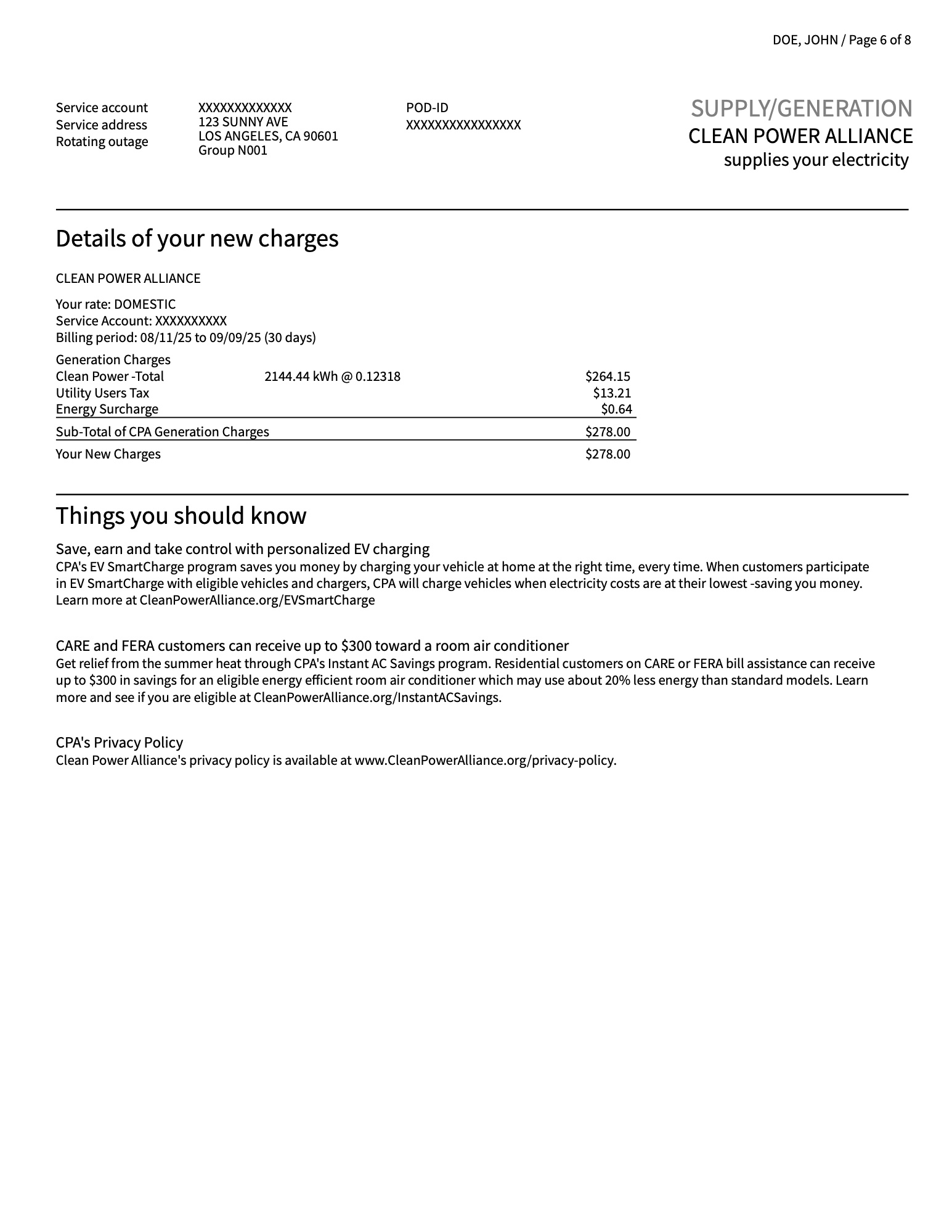
Clean Power Alliance supplies it
A community power provider buys the electricity. SCE still delivers it and sends the bill, and the power gets its own page.
The power: 12.3¢ a kWh
2,144 kWh × $0.12318 = $264.15. This is the electricity itself; everything on page 4 is getting it to you.
The city's tax, again: $13.21
The Utility Users Tax applies to the power as well as the delivery.
$278.00 for the power
Add the $576.44 delivery line and the bill comes to $854.44.
How SCE prices your power
Two companies, one bill
SCE always delivers the power and sends the bill. The power itself comes from SCE or, in many cities, a community power provider like Clean Power Alliance, with its own page. Read only the SCE part and you miss about a third of this bill.
Baseline and the time of day
On the tiered plan, power up to your baseline costs less and everything above costs more; the baseline depends on your climate zone and the days in the bill. Most homes are on time-of-use plans instead, where the most expensive hours are 4 to 9 p.m., after the sun has gone down on your roof.
Source: SCE time-of-use plans
Ten years of rates
SCE's average residential rate rose about 101% over ten years and 56% over five, according to the CPUC's Public Advocates Office.
Solar with SCE
New systems are on the Net Billing Tariff: power sent back to the grid earns much less than power bought from it, so a battery stores the daytime sun for the 4 to 9 p.m. hours. Income-qualified homes may get 32.5% (CARE) or 18% (FERA) off the bill.
Source: SCE Schedule NBT, SCE CARE and FERA
Also explained: LADWP · PG&EQuestions about your own bill? Call (619) 415-9647.